

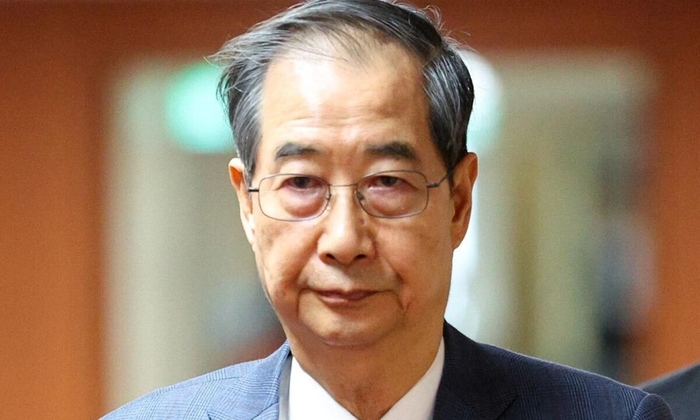
As preparations for Han Duck-soo’s presidential campaign gain momentum, key members of the Prime Minister’s Office have begun stepping down. Han, currently serving as acting president and prime minister, is expected to declare his candidacy in early May. Sources anticipate that he will initially run as an independent before pursuing a unification with the People Power Party (PPP) nominee.
On April 28, Son Young-taek, Chief of Staff to the Prime Minister, tendered his resignation, which Han immediately accepted. In a farewell address to staff, Son thanked them for their support and expressed hope to meet again with good spirits. Son, considered one of Han’s closest confidants, previously ran for the Liberty Korea Party—the predecessor of the PPP—in the 2020 general elections.

Observers widely interpret Son’s departure as groundwork for Han’s upcoming campaign team. Additional political appointees, including Public Relations Chief Kim Soo-hye, are also expected to resign soon to join Han's effort. Meanwhile, speculation is growing that former Land Minister Won Hee-ryong is quietly backing Han’s candidacy. According to a PPP insider, “Son has longstanding ties to Won, and Kim also supported Won during the last presidential race. Won’s current silence, despite announcing he would not run, is telling.”
Although Han was initially rumored to resign by April 30, his departure now appears likely to occur in early May. The Prime Minister’s Office is currently arranging a meeting between Han and U.S. Secretary of the Navy John P. Phelan, who is visiting Korea on the 30th. Phelan plans to tour Korean shipyards and discuss ship maintenance, repair, and overhaul (MRO) cooperation, with Han aiming to leverage the meeting to strengthen ties with the U.S. One official mentioned that Han could process his own resignation without needing approval from higher authorities.

Internally, Han’s team is also deliberating over his political affiliation. Some argue that running as an independent could better position Han to lead a broad anti-Lee Jae-myung coalition—bringing together centrist and progressive figures such as Innovation Party candidate Lee Jun-seok and New Future Democratic Party advisor Lee Nak-yeon.
Nonetheless, political analysts overwhelmingly predict that Han will eventually need to forge a unity deal with the PPP candidate. Given the logistical demands of a nationwide campaign—including organizational infrastructure, campaign financing, and electoral ballot rankings—an independent or third-party bid would be highly impractical. To claim the PPP’s official No. 2 ballot designation, Han must conclude any unification negotiations before the May 11 candidate registration deadline. A senior PPP figure emphasized, “Winning a nationwide election without a major party's support is virtually impossible.”

On the same day, Han had no public engagements, focusing instead on reviewing outcomes from recent U.S.-Korea trade negotiations. Speaking to The Economist, Han expressed confidence that tariff disputes with the U.S. could be settled through non-confrontational dialogue. He described Washington’s 25% reciprocal tariffs as “shock therapy” and acknowledged the significant harm done to Korea’s automotive and steel industries.
Han also stressed the strategic importance of liquefied natural gas (LNG) ventures, particularly highlighting a major project in Alaska involving a 1,300-kilometer pipeline and liquefaction facilities intended for Asian exports. He suggested that Korean and Japanese firms could benefit from participating. On the topic of non-tariff barriers, Han hinted at possible improvements, suggesting, for example, easing current restrictions that limit the functionality of Google Maps due to data export controls.